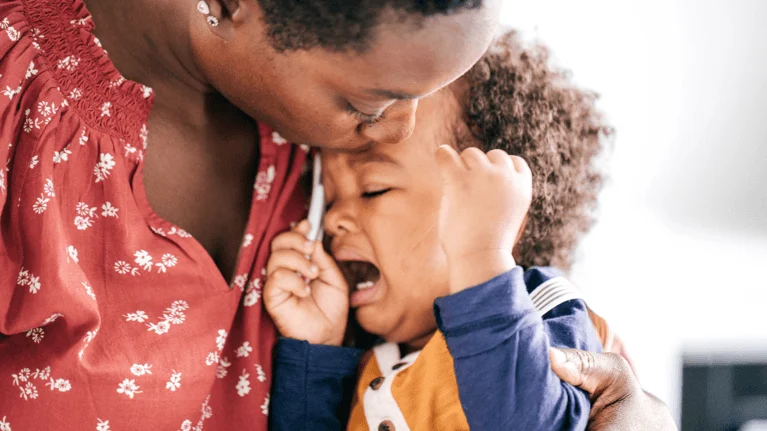
Licensed clinical psychologist Emily Edlynn tells us how we can help toddlers through their temper tantrums.
Why Is Anger Management Tough To Teach?
I have noticed in my work with families, and in real life knowing anyone parenting children, that anger can be our toughest emotion to navigate. Our childhood experiences with adults expressing anger can play out with our own children. Seeing our child’s anger may be an emotional trigger for those whose caregivers blew up easily, or unfamiliar territory for those whose caregivers withdrew and went silent when angry, communicating that expressing anger is not permitted.
Because anger makes us uncomfortable for a range of reasons, we often convey to our children to express emotions, except anger. If we get more comfortable with anger as a natural human emotion, we help our children embrace their own, eventually without hurting anyone—or growling.
Anger and the Young Brain
The young child has the brain parts to feel strong emotions suddenly, but not yet the brain development to harness these emotions. In working with children in my therapy office, I start with the basics of emotions with almost every child regardless of age, like noticing how they feel in their bodies, labeling the feelings, and then articulating emotions to eventually replace exploding behaviors.
In my years of therapy practice and motherhood, I can attest that young children most often do not have the ability to calmly state how they are feeling when angry. It’s too complex for their brains. Doing so entails:
- Noticing
- Stopping a strong impulse
- Having insight
- Being able to put words to a highly emotional experience
(Side note: How many adults do you know who struggle with this?)
How To Manage Expectations
There’s a very important concept from child development critical for your dilemma: scaffolding. This refers to helping our children build important skills in a way that matches the skills they already have, and their readiness to level up.
You have done this by helping your daughter replace destructive acts of anger with facial expressions and vocalizations that express her anger safely. It sounds like you see the next level as replacing this type of expression with behavior that feels more socially appropriate.
Because it is probably a high bar for a 3-year-old to express anger calmly with words, I recommend focusing on two goals as the next developmental steps:
- Physically regulating strong emotion: This coping skill will help dial down the intensity of anger, giving her emotional regulation tools to last a lifetime.
- Becoming comfortable with her anger: Adults and other caregivers will be her greatest emotional teachers in this regard. Work on modeling this good behavior.
Co-Regulation is Key
This may sound a bit fancy, but self-regulation is actually one of our most powerful strategies for emotional health: learning to calm our bodies when in distress. Regulating with your daughter, called co-regulation, helps her feel how her nervous system shifts from high alert to calm. High alert, which happens when we feel intense emotions like fear and anger, can include a racing heart, heated up body temperature, tense muscles, and rapid breathing.
When my son gets heated, sometimes I take his hand in mine, put it on his chest, and simply say, “feel your heart right now.” When toddlers get mad, they need us to regulate with them, which means we need to be regulated (calm). When we stay calm and offer physical comfort like hugging, sitting them on our laps, or holding hands, our calmer nervous systems help their little bodies better regulate those big emotions.
Modeling Anger Acceptance
The next greatest gift you can offer as a parent is modeling that anger is an acceptable emotion. We achieve this by showing that we are comfortable with our children being angry. This means avoiding two common traps: talking them out of their anger and becoming overwhelmed by it ourselves.
Our youngest children’s anger can look quite ridiculous on the surface, so it’s easy to say, “this is so not a big deal—calm down!” (I’ve done it.) When possible, however, validating “you’re angry because you’re not getting what you want and that is really hard,” offers empathy that goes a long way.
I’ve had my share of moments wanting my kids to just stop being upset, but I’ve learned how important it is to stick in there with the distress as often as I can and to resort less often to shutting down the anger (my own yelling) or escaping it (tuning out with some Facebook scrolling). Just like when they are sad and you sit next to them rubbing their backs while they cry, you can show them they can feel angry and get through it: “I see you are really angry. I’m here when you’re ready to sit in my lap.”
Note: We accept all emotions, but not all behaviors. While they are angry, we continue supporting safety. “It’s fine to be angry, but not to punch me.”
Once their bodies are calm, you can then guide dialogue about what made them mad, how it felt, and what helped it pass. This helps children practice self-awareness, identify coping strategies, and build confidence that anger passes, just like the scariest thunderstorms eventually end.
The Bottom Line
With time, practice, and buckets of patience, I promise your daughter will progress beyond the angry animal stage. Accepting the emotion of anger itself while you work on expression skills at each developmental stage will prepare her well for long-term emotional health. She’s fortunate to have such a wise and invested parent, even if you get angry about her anger sometimes. After all, you’re both only human, and at least she knows you’ll always be there for her. Even when she growls.
Emily Edlynn, PhD, is the author of The Art and Science of Mom parenting blog and the book Parenting for Autonomy. She is a mother of three from Oak Park, Illinois, and a clinical psychologist in private practice who specializes in working with children and adolescents.
___
Discovery Point is a daycare in Woodbridge, Ontario